%201.avif)
-(1).png)

Palate Expanders for Adults: Do They Work, What They Cost, and What Results Look Like
When most people think about a palate expander, they picture an appliance used to widen the jaw of children. But what happens if you're an adult with a narrow upper jaw?
Well, luckily a palate expander for adults exists, but it's a bit different in some key ways.
Your upper jaw is essentially two halves that meet at a seam that runs down the middle of your palate, called the midpalatal suture. When you're a child this seam is soft, and a palate expander can anchor onto the back molars, separating the two halves easily. Bone then fills in the gap, which keeps the jaw in its widened position.
With age, this middle seam grows interlocked, and the bones stiffen around it. Under these circumstances, a childhood palatal expander that anchors to teeth usually can't split the seam, with most of the force going into the teeth instead, pushing them outward. While this might look like a wider arch, it doesn't actually create a wider jaw. Because of this, adult palate expansion requires an expander that's anchored in bone rather than teeth, or in some cases can require surgery.
Everybody's palate develops differently, and there are many factors that determine if an adult palatal expander could effectively widen your jaw, or if surgery makes the most sense. Ultimately, the only way to know what's possible is to get a 3D scan and an evaluation from an orthodontist experienced in adult palatal expansion.
In this guide, we'll go over how palate expanders for adults work, what all of the options are for adult palatal expansion, what treatment costs, and what results will look like.
What Is a Palate Expander?
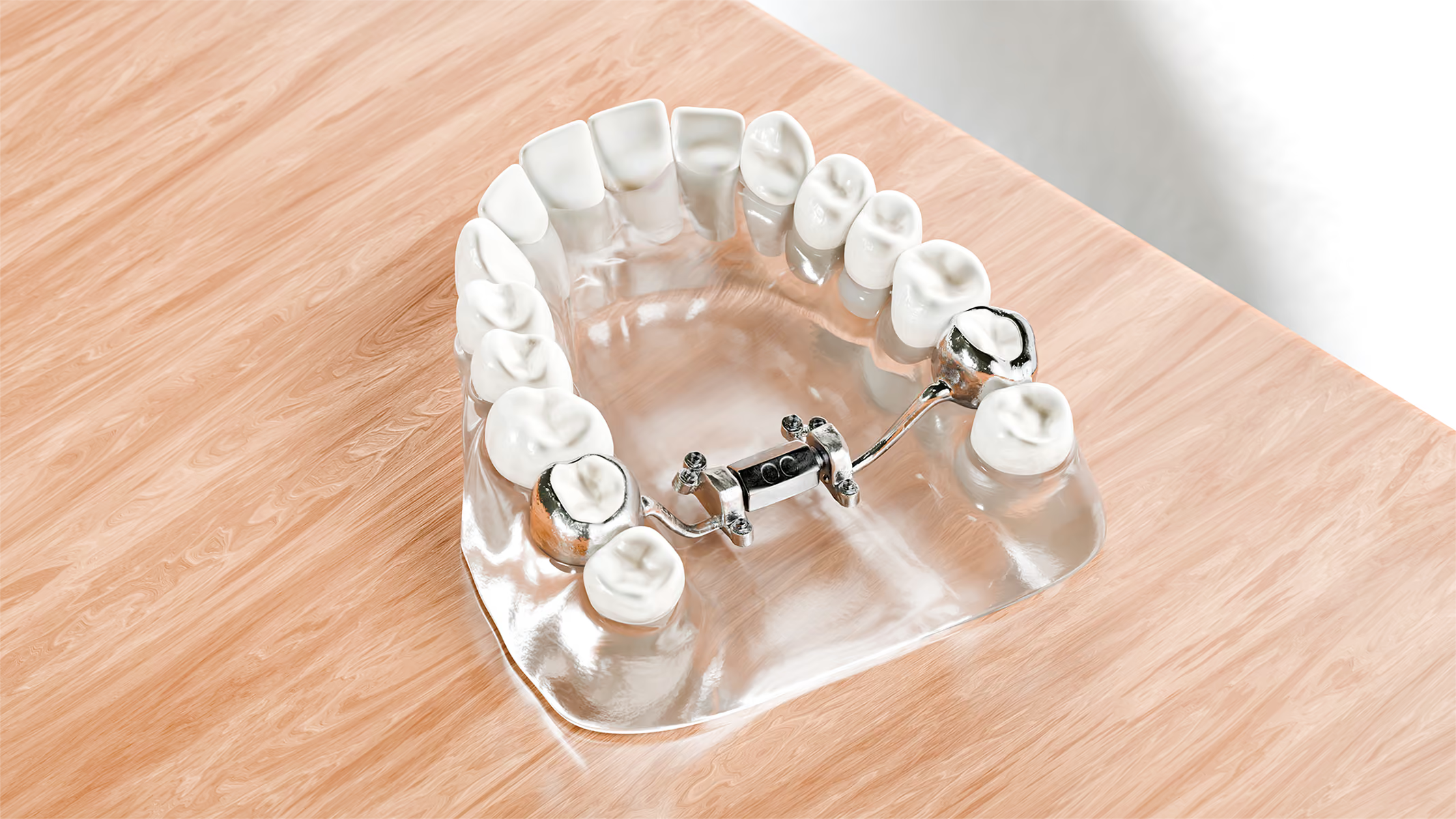
To start off, what does a palate expander do? Well, a palate expander, also called a palatal expander, or informally, an expander for teeth, is an appliance that broadens a narrow upper arch.
A widened arch can correct the following:
- Posterior crossbite, which is when the upper back teeth fall inside of the lower ones.
- Tooth crowding caused by insufficient arch width
- Buccal corridors, which are dark triangles that show at the corners of a smile
- Tongue space, where a wider palate gives the tongue room to rest against the roof of the mouth
- For children, impacted teeth that aren't able to erupt due to a lack of space
- In select circumstances, nasal airflow, as the palate forms the floor of the nose and widening it can reduce nasal resistance. However, expansion on its own is not a treatment for breathing or sleep disorders
How Do Palate Expanders Work?
Most palatal expanders work by turning a small screw in the middle of the appliance a fraction of a millimeter once or twice a day until the arch reaches its planned width. Other expanders use built-in springs or wires and never need turning. Either way, forces are applied outward in order to push your arch wider.
What changes with age is anchorage. A child's expander will apply force to the back teeth. Meanwhile, an adult palatal expander applies force to miniscrews that are set into the palatal bone, so that the force goes into the bone instead of the teeth.
Palatal Expansion Timeline
Active palatal expansion (the time when you're actually turning the screw) is typically faster in children than adults. A child's active expansion period often lasts a few weeks, while an adult's can range anywhere from several weeks to a few months. This is due to the fact that seam rigidity requires a more gentle and gradual protocol.
Once the desired arch width is achieved, the screw is locked in place and the appliance stays in this position for months as bone fills the gap. Adults generally need around 6 months here, as adult bone fills in more slowly than a child's. This period is what makes the expansion permanent.
It's important to note that turning your expander more than your orthodontist tells you to won't shorten the overall timeline. In fact, it can loosen or fracture the appliance, irritate your teeth and gums, and impact your body's ability to effectively build bone in the gap. Conversely, if you end up skipping days, this can have the negative consequence of the seam beginning to close before expansion is finished.
Signs You May Have a Narrow Upper Jaw
The best way to know if you have a narrow upper jaw and to understand how it could be impacting your oral health is to see an orthodontist. However, there are several visible signs you may be able to notice on your own:
- Dark spaces at the corners of your smile. When you smile wide, if there are gaps between your back teeth and cheeks, this could be a sign of a narrow arch.
- Upper back teeth falling inside your lower ones when you bite down. With a correct bite, your upper molars sit slightly outside your lower ones. When they don't, that's what's known as a posterior crossbite.
- Teeth crowding. Crowded or overlapping teeth can be a sign that your arch is too narrow to fit them, especially if you've had braces and your teeth have since shifted back.
- A high, vaulted roof of the mouth. If the roof of your mouth arches steeply and your tongue can't rest flat against it, then your palate may be too narrow. Scalloped edges along your tongue can also be a related clue.
- Chronic mouth breathing or nasal congestion. Your palate is the floor of your nose, and due to this relationship, a narrow palate can often accompany a narrow nasal airway. Breathing and sleep concerns should be evaluated by a physician as well to determine the best treatment.
These are all reasons to get checked and evaluated by an orthodontist, not conclusions. An orthodontic exam and a 3D scan will be able to reveal the true nature of what's going on.
Can Adults Get a Palate Expander?
If you arrived at this article wondering “can you get a palate expander as an adult?” you now know that the answer is yes. But even more, adult palatal expanders can be an effective treatment option more often than many people realize.
Age used to be a cutoff for palatal expander use. Two things changed that: appliances that anchor into bone rather than teeth, and 3D imaging that shows how much a person's palate has actually fused. Histologic research summarized in the American Journal of Orthodontics and Dentofacial Orthopedics documented the seam fusing in subjects as young as 15 and no fusion at all in others aged 27, 32, 54, and even 71.
This shows that everyone is different, and candidacy is less about age and more about what's revealed in the 3D CBCT scan. So, can adults get palate expanders that genuinely widen the jaw? Many can, and the specific method that's used is a matter of your unique case.
Your Options For Adult Palatal Expansion
Adult expansion comes in five forms, and which one is right for you is largely dependent on how the seam and surrounding bone have changed over time.
MARPE, including MSE
This is a miniscrew-anchored jaw expander for adults that works by placing titanium screws into the palate under local anesthetic, which the expander then connects to, applying expansion forces directly to the bone instead of the teeth. When a patient is a good candidate for this treatment, the seam can be separated without the use of jaw surgery. You may see MSE talked about as a separate treatment from MARPE, but the reality is MSE is simply one design of MARPE. It's just the best known.
SARPE
When the seam and the surrounding buttresses won't give, an oral surgeon is able to release them and an expander is then used to actively widen the jaw over the next couple of weeks, followed by a multi-month consolidation period. There are situations when this is the most effective option, but it's more involved and comes with a real recovery period.
Segmental Le Fort I
This is a surgical widening that is built into broader jaw surgery when width is just one of several corrections needed to bring a person's jaws and bite into alignment.
Conventional RPE
This refers to the palatal expander used during childhood, and is the kind of jaw expander that most people picture. It's still an option for young adults whose seam hasn't fused.
Dentoalveolar (arch) expansion
Braces, aligners, or a removable palate expander can tip teeth outward in order to round out a narrow-looking arch. An arch expander for adults moves teeth, not bone, so while it can be great for mild crowding, it's not skeletal expansion.
Can Invisalign Expand Your Palate?
Invisalign expansion can refer to two different things, but only one of them is skeletal, so it's important to understand the distinction.
Invisalign aligners aren't able to expand your palate skeletally, but can broaden the arch by a few millimeters by tipping teeth outward. For mild crowding, Invisalign may be enough.
The Invisalign palatal expander is then a different product entirely. It's a 3D-printed removable device that received FDA clearance in 2023, and is a way to expand the palate skeletally. But it isn't built for adults. It's made for early childhood treatment, typically ages 6 to 10.
So, can Invisalign expand an adult palate skeletally? No. For adults, real expansion means an expander that is anchored in bone or surgery, and an orthodontist would need to evaluate your bite and jaws in order to determine the most effective path forward.
Do Palate Expanders Hurt?
Understandably, many people wonder, are palate expanders painful? And the answer is that it's typically more of a feeling of pressure than sharp pain. That said, you can expect the first days of expansion to be the hardest part.
To put it into perspective, a study of 42 MARPE patients averaging 27 years old, published in BMC Oral Health, found that pain peaked right at the start of expansion, with patients rating their worst pain as moderate. 59% of patients took over-the-counter medication for pain relief. Pain levels then dropped to very mild for the remainder of treatment and quality-of-life scores returned to normal once active expansion was finished.
The feeling that most people describe when it comes to each turn of the screw is a firm pressure on the roof of the mouth for a few minutes. However, each individual's experience is different. For adults, the part that sounds the worst (the placement of the miniscrews into the palatal bone) usually isn't. That's done under local anesthetic. Instead, studies have found that the first few days of expansion turns have higher reported ratings of discomfort than the week after screw placement.
Something else that's worth a heads up is that a gap may open between your front teeth during expansion, but that's normal and is actually a clear sign that expansion is skeletal. Not to worry, this will close during alignment following expansion.
How Much Does a Palate Expander Cost?
Cost can't be boiled down to a single number, because every case is different, and any website quoting one is likely pricing something that isn't reflective of the exact treatment you need. The answer to how much does a palate expander cost depends on a wide range of factors.
The first factor to consider is the method. A conventional expander is the least expensive, while a miniscrew-anchored expander costs more, and a surgical approach costs the most.
What's included in the quote also matters, as expansion is usually just one phase of a more comprehensive plan. So when you ask how much is a palate expander, make sure you clarify that you're looking for the cost of the entire treatment plan including imaging, the appliance, activation visits, retention, and the alignment treatment (braces, aligners, etc.) that follows.
Does Insurance Cover a Palate Expander?
You also might be wondering: how much does a palate expander cost with insurance? And the reality is that it varies dramatically based on the type of coverage you have. Dr. Yoon is an out-of-network provider but if your plan includes an orthodontic benefit, we will verify your coverage before you commit to treatment and then file a claim on your behalf. We also offer in-house financing at 0% interest.
Does a Palate Expander Change Your Face?
A palate expander can change your face slightly, giving your smile a broader appearance and widening the base of your nose marginally. The effect is more pronounced in children, as their bones are still growing.
In adults it's a relatively small change. A prospective study published in Clinical Oral Investigations followed 29 MARPE patients aged 17 to 47 for a year after expansion. They discovered that the upper arches of the patients widened by an average of 4.58 mm, but the facial soft tissue moved by less than a millimeter. The authors concluded that MARPE doesn't notably affect the midfacial soft tissues. This means significant widening in the mouth doesn't necessarily translate to visible changes on the outside of the face.
So when you come across claims online promising significant changes to your face, just know that a fraction of a millimeter is actually the likely change. Will there be some changes to your face? Slightly, yes. But by no means will it be a facial transformation.
Palate Expander Before and After: What Results Look Like
The biggest palate expander before and after change isn't cosmetic. It's the arch itself.
Before: The upper arch is narrow and often V-shaped. The teeth may be crowded, overlapping, or blocked from erupting. Often a posterior crossbite is a clear sign that the upper arch is too narrow, as well as dark triangles in the corners of a wide smile.
During: Within the first week or two of turning, a gap may open up between the upper front teeth and is the clearest visible sign that the two halves of the upper jaw have separated rather than the teeth simply tipping outward. This is a good sign, not something to be alarmed about.
After: When treatment has been completed you will have a broader, U-shaped arch with room for every tooth. Your back teeth will meet correctly and you'll have a fuller smile line where the dark triangles in the corner used to be.
It's worth explicitly mentioning that the expander is used to create space, but it doesn't produce the finished result. In order to bring your teeth into alignment after the arch has been widened you'll undergo braces or clear aligner treatment to put the finishing touches on your smile. When you see before-and-after photos of adult palate expansion, you're almost always seeing the result after the alignment phase, not just after expansion.
See a Manhattan Orthodontist About Adult Expansion
The best treatment option for adult palatal expansion isn't determined by a birthday, and it can't be decided with the naked eye. The answer comes down to imaging and the evaluation of your jaw by an orthodontist experienced with adult expansion. Dr. Sean Yoon is a board-certified orthodontist in Midtown East who focuses on MARPE and adult palatal expansion. Using 3D CBCT imaging, he can help you determine which expansion method makes sense and walk you through what treatment looks like. If you're in Manhattan or anywhere else in NYC, book your consultation today.
Sources
- Angelieri F, et al. Midpalatal suture maturation: classification method for individual assessment before rapid maxillary expansion. American Journal of Orthodontics and Dentofacial Orthopedics, 2013.
https://www.ajodo.org/article/S0889-5406(13)00746-4/fulltext - Kapetanović A, Noverraz RRM, Listl S, Bergé SJ, Xi T, Schols JGJH. What is the oral health-related quality of life following miniscrew-assisted rapid palatal expansion (MARPE)? A prospective clinical cohort study. BMC Oral Health, 2022;22(1):423.
https://link.springer.com/article/10.1186/s12903-022-02444-3 - Krijt LL, Kapetanović A, Sijmons WJL, et al. What is the impact of miniscrew-assisted rapid palatal expansion on the midfacial soft tissues? A prospective three-dimensional stereophotogrammetry study. Clinical Oral Investigations, 2023;27(9):5343–5351.
https://pmc.ncbi.nlm.nih.gov/articles/PMC10492756/ - Cleveland Clinic. Palate Expander: Uses, Types & Adjusting.
https://my.clevelandclinic.org/health/treatments/23502-palate-expander