%201.avif)

MARPE Explained: How Adults Can Widen the Upper Jaw Without Jaw Surgery
You're likely here reading this article because you're an adult who's discovered they have a narrow upper jaw. Maybe you've been told you need jaw surgery, but are curious if there's alternative options. Or maybe you've already explored some alternatives and want a deeper understanding of MARPE. Well, either way you're in the right place, and the reality is for many adults, the upper jaw can be widened without surgery.
In this guide we'll cover how MARPE works, how it differs from other appliances, how long it takes, who qualifies, and when surgery is still the better answer. If you want a more general overview of your options, start with our overview of adult palatal expansion options.
What is MARPE?
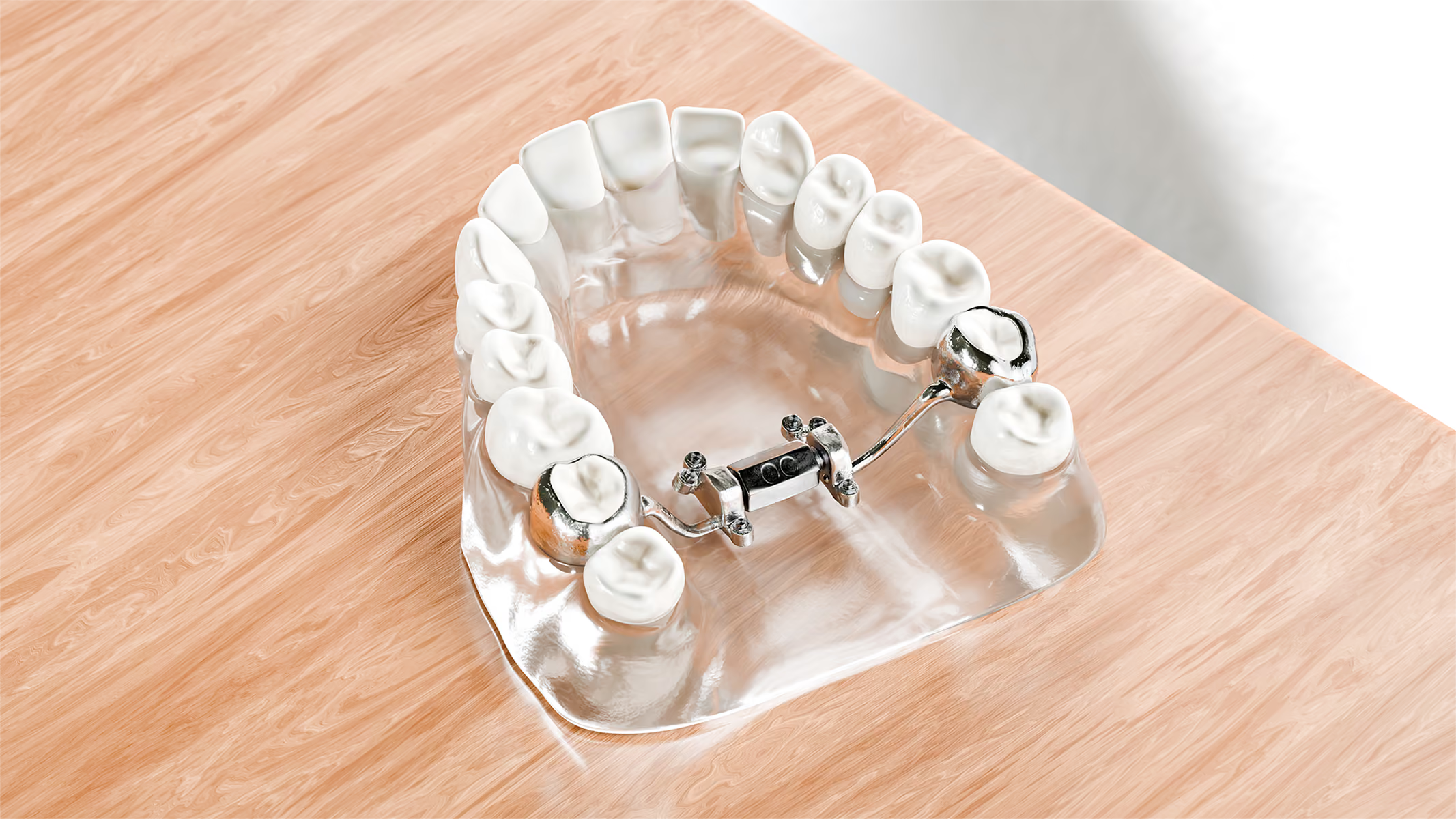
MARPE is an orthodontic appliance that is used to widen the upper jaw by anchoring into the bone of the palate rather than applying force to the back teeth, like a conventional palate expander does.
What does MARPE stand for?
Miniscrew-Assisted Rapid Palatal Expansion
What does MARPE do, practically?
It separates the midpalatal suture, which is the seam where the two halves of your upper jaw meet, running down the middle of the roof of your mouth from front to back. Your upper palate isn't one solid bone. It's two halves that are joined along that seam. When you're a child, that seam is soft and gives way easily, but with age, it interlocks and hardens.
Separating that seam allows the two halves of the upper jaw to move apart, and new bone fills the gap. MARPE is a way for adults to achieve true skeletal expansion instead of simply tipping a person's teeth outward to give the appearance of a wider jaw.
Something to note is that MARPE is a category, not a single product, so there's a good chance you'll also see this treatment method discussed under different names.
How Does MARPE Work?
What makes MARPE unique is that it anchors to bone instead of teeth. A MARPE expander has two pieces of hardware that can be easy to confuse.
The first is miniscrews, which are small titanium screws placed into the bone of the palate under local anesthetic. They don't move once they've been placed, and they act as the anchor points for force to be applied.
The second is the expander screw, which sits in the middle of the appliance and is what gets turned. Each partial turn, or “activation,” pushes the two halves apart a fraction of a millimeter at a time until the arch is widened to the desired amount. How much, how often, and how long you turn it depends on your case, and will be determined by your orthodontist.
The anchorage of the miniscrews is why MARPE expansion works for adults when a childhood expander doesn't. A conventional expander applies force to the molars, which works in a child whose seam hasn't fused. But in a mature jaw, when the seam has become interlocked and rigid, the resistance that's created redirects the forces into the teeth. This causes the teeth to move instead of the bones of your palate. A MARPE appliance applies forces directly into the palate, so the work is done by the bone rather than absorbed by your teeth.
MARPE vs MSE vs Traditional RPE
This comparison gets framed wrong on a lot of different websites, so let's clear up the confusion. MSE and MARPE aren't competing treatments. Rather, MSE is a type of MARPE.
Meanwhile, traditional RPE is in reference to palatal expanders that attach to the molars. RPE orthodontics is great for children whose seam is still soft enough that force can be delivered to the teeth without issue. In a mature jaw, where the seam has become rigid, an RPE expander mostly moves teeth rather than bone.
MARPE is the broad category term for miniscrew-anchored expanders. MSE (maxillary skeletal expander) is then the best known design within the category. It was designed by Dr. Won Moon and is defined by four miniscrews that are long enough to pass all the way through the palate, gripping the hard outer layer of bone on both sides (the roof of your mouth and the floor of your nose). This method of anchoring into two dense layers of bone instead of one is known as bicortical engagement and is a way of gaining more stability. That stability ultimately allows the jaw to open more evenly front to back, rather than wedging open more at the front than the back. An MSE expander is a MARPE expander like how a square is a rectangle.
Are You a MARPE Candidate? What a CBCT Scan Shows
Whether or not you're a MARPE candidate isn't determined by looking in your mouth or simply going off your age. What determines your candidacy is what's discovered in your CBCT scan.
The midpalatal suture doesn't fuse on a fixed schedule. In fact, research summarized in the American Journal of Orthodontics and Dentofacial Orthopedics documented the seam fusing in patients as young as 15, and remaining completely unfused for others aged 27, 32, 54, and even 71.
Every single case is different and the only way to know the actual state of your palate is to get a CBCT scan.
What will the scan show?
- How far the seam has closed: Orthodontists use a staged system to classify how the midpalatal suture has matured. In earlier stages, the suture is generally able to separate without surgical help, while in later stages it can't.
- How much bone you have to anchor into: Miniscrews need the palatal bone to be a sufficient thickness, so the screws can be stable enough to withstand the forces placed on them during expansion.
- The condition of the surrounding structures: Resistance to expansion doesn't only come from the seam. Each half of your upper jaw is also attached to the rest of your skull and those attachments stiffen with time. So, sometimes even when that midpalatal suture is ready to give, the bone around the jaw can put up a road block.
When the conditions line up, MARPE is a great palate expansion option. Outcomes for MARPE expander adults treatment are now well documented with a 2023 meta-analysis published in BMC Oral Health reporting a mean success rate of 93.87% across the studies that it pooled. This average was across a wide range of ages and appliance designs, so it's not a prediction for any one case.
Dr. Yoon screens every adult expansion case this way before recommending a method. Every case is different, because everyone's anatomy is unique. Dr. Yoon takes into account every small detail, and makes sure that your treatment is truly right for you.
MARPE vs SARPE: Which Do You Need?
If imaging shows that your midpalatal suture can still be separated, then MARPE is a great option. If it can't, then SARPE (surgically assisted rapid palatal expansion) may be needed.
For SARPE, an oral surgeon releases the seam and any other structures keeping the palatal bones held in a rigid structure, allowing for an expander to then actively widen the jaw over the following weeks.
When it comes to MARPE vs SARPE, one option isn't inherently better than the other, they just treat different anatomy.
MARPE is a great first consideration, because it avoids an operating room, general anesthesia, and a surgical recovery.
SARPE surgery then becomes the right option when the seam is fully fused, when correction needed is beyond what non-surgical expansion is reliably able to achieve, or when MARPE has been attempted without success.
Jaw expansion surgery as part of a larger orthognathic plan is another scenario when adding width to the upper jaw is only a piece of a larger treatment need.
Ultimately, the scan will drive the recommendation.
How Long Does MARPE Take?
For most adults, the answer to how long does MARPE take, is nine to twelve months of the appliance being in place. However, every patient and case is different, so timing varies.
You can split the timeline into two different phases:
Active expansion is the first part where you're turning the screw. If you're wondering how long does MARPE expansion take, this is the time you care about. This stage typically lasts anywhere from several weeks to a couple of months, and is longer than a child's active expansion window, due to the fact that adult protocols need to be slower and more gentle.
Holding is the longer part, and this is the time when the result becomes permanent. Once you reach the planned width, the expansion screw is locked, and the appliance stays put. For most adults this period lasts for around 6 months. During this time, bone fills into the gap that expansion created. This process is slower in adults than children, which is why this phase of treatment is longer than some people expect. But it's critical for the long term stability of your result, because if this stage is cut short, it can lead to the jaw narrowing back.
Following expansion, alignment with braces or aligners typically follows, or overlaps with that second phase.
How Much Does MARPE Cost?
There isn't a single number, and any website that you'll see quoting one is going to be pricing something that is different from your case. How much does MARPE cost depends on the appliance design, how much correction you need, and more than anything, what else is needed in the plan. Expansion is almost always one part of a more comprehensive treatment plan to bring your mouth into harmonious balance.
When you're exploring your palatal expansion options and are asking the question of “how much is MARPE,” make sure you're getting the figure for the treatment plan as a whole. A comprehensive quote should include:
- Records and CBCT imaging
- The appliance and miniscrew placement
- Activation and monitoring visits
- The retention period
- The alignment phase that follows expansion
A quote for the appliance alone won't be what you actually pay. At Yoon Orthodontics, we'll make sure to give you a comprehensive breakdown of cost before we ever get started.
Is MARPE Covered By Insurance?
If you're wondering, “does insurance cover MARPE?” the answer isn't cut and dry, but there are many situations where MARPE is partially covered if your insurance has an orthodontic benefit.
Is MARPE covered by insurance in full ever?
Rarely. But if your plan includes an orthodontic benefit, we will make sure to verify your coverage before you commit to treatment and then file the claim on your behalf, so the reimbursement comes back to you.
We also offer in-house financing at 0% interest.
MARPE Before and After: What Changes
Before: The upper arch is often narrow and V-shaped. This can lead to crowding and blocked-out teeth, and a posterior crossbite is also often a symptom of the upper jaw being too narrow.
During: In many cases, a gap will open between the upper front teeth, which can alarm people, but this is actually a good sign, as it shows the seam has separated and real skeletal expansion is happening rather than the teeth simply tipping outward. This gap will be closed during alignment.
After: The upper arch will be broader and more U-shaped. This will add space for teeth to be aligned properly and will make it so your molars meet correctly when you bite down. Overall you'll have a fuller smile line.
What MARPE Treatment Looks Like at Our Midtown East Office
Consultation and Records
The first step is an exam where Dr. Yoon will evaluate your jaws, bite and teeth, and use a CBCT scan to determine if MARPE is a realistic treatment option for your anatomy. If you're not a good candidate he'll explain why and help you figure out what a better option would be.
Placement
The appliance is fitted and miniscrews are placed under local anesthetic during a single appointment, and most patients are back to normal the same day. Some soreness at the screw sites is normal, but generally this discomfort is less than people anticipate.
Activation, Then Holding
Turning and active expansion usually begins right away or within a few days of placement, with no wait time for the miniscrews to heal in. Between visits you'll turn the expansion screw on a set schedule, and then when you do come in for a visit we'll see how the separation is progressing through imaging. After the active expansion period, the screw will then get locked and the appliance will stay in place while bone fills the gap.
Alignment
After expansion we'll use braces or aligners to finish the result, bringing your teeth into proper alignment.
Frequently Asked Questions
Does MARPE hurt?
Not sharply, as it's more pressure than pain. The first days of active expansion are typically the hardest part. In our guide to palate expanders for adults we break down what the research found on does MARPE hurt.
Does MARPE change your face?
MARPE can change your face slightly, but it's less than the internet may have you believe. Soft tissue typically moves less than a millimeter in adults, even when the actual arch is moving several millimeters.
Is MARPE forward growth real?
There's typically a small forward movement of the nose and upper lip that persists after treatment, but it's fractions of a millimeter and is not the MARPE forward growth you may see described in online forums.
Can MARPE fail?
Yes. If the seam doesn't end up separating, or if there isn't enough palatal bone for stable anchorage, you could experience failed treatment, but this is why determining initial candidacy through CBCT scans is so important. If MARPE does fail, then SARPE is usually the next step.
Will I need braces after MARPE?
Almost always. This is because expansion creates space, and braces or aligners are what position the teeth within this newly developed space.
Book a MARPE Consultation in Manhattan
The only way to know if MARPE will work for you is a clinical exam and a 3D scan. Dr. Sean Yoon is a board-certified orthodontist in Midtown East who has a strong background in adult palate expansion, screening every patient with CBCT imaging before recommending a treatment method. He wants to find a method that's truly best for your individual case and will be honest with you when surgery makes the most sense. So book your consultation today at Yoon Orthodontics in NYC.
Sources
- Angelieri F, et al. Midpalatal suture maturation: classification method for individual assessment before rapid maxillary expansion. American Journal of Orthodontics and Dentofacial Orthopedics, 2013.
https://www.ajodo.org/article/S0889-5406(13)00746-4/fulltext - Long-term efficacy and stability of miniscrew-assisted rapid palatal expansion in mid to late adolescents and adults: a systematic review and meta-analysis. BMC Oral Health, 2023.
https://pmc.ncbi.nlm.nih.gov/articles/PMC10623697/

-(1).png)